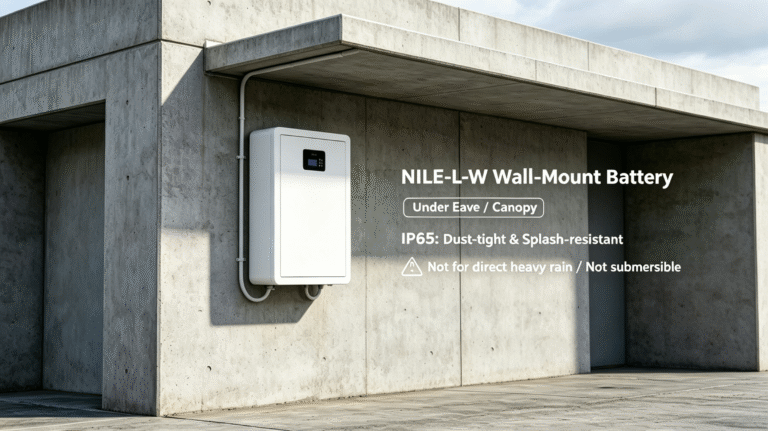
Australia’s national battery installation standard AS/NZS 5139:2019 Amendment 1:2025 took full effect on 19 June 2026, bringing updated safety rules for residential lithium energy storage systems. The revision clarifies installation clearances, fire barrier rules, paralleling protection and documentation obligations, directly affecting importers, distributors and CEC-accredited installers supplying home batteries across Australia.
1. Core Updated Installation Rules
The amendment fixed ambiguous clauses from the original 2019 version. The key changes that impact on-site installation are listed below:
Safety barrier requirement: Any barrier separating the battery pack from habitable rooms must be a minimum of 6 mm thick. Thinner non-certified barrier materials are no longer acceptable for compliance inspections.
Clearance & opening rules: Batteries can be placed within 600 mm of an opening such as a garage door, only when that opening is wider than 900 mm. The strict 600 mm restriction still applies for windows connected to living areas.
Inverter placement: Hybrid inverters are now classified as associated appliances. They can be installed inside the restricted battery zone, which saves wall space for residential setups.
Paralleled battery fault protection: Over-current protection devices for parallel battery banks must have a kA short-circuit rating matching or exceeding the total combined fault current of all connected battery modules.
SDS document requirement: A physical, durable copy of the battery Safety Data Sheet (SDS) must be kept on-site in a sealed waterproof pouch for inspection by electrical safety officers.
2. Mandatory Market Entry Compliance for Australian Home Batteries
Before a lithium battery storage product can be sold and installed for Australian residential PV projects, two core compliance layers must be completed:
1.RCM Mark & EESS Registration
All lithium battery packs for grid-tied residential use require the RCM regulatory compliance mark, registered on the national EESS electrical safety database. RCM covers electrical safety (AS/NZS 62619), EMC and labelling rules. Without valid RCM registration, the product cannot be imported, advertised or installed legally in Australia.
2.CEC Approved Listing
To qualify for STC rebates under the Small-scale Renewable Energy Scheme and the federal Cheaper Home Batteries Program, the battery model must be added to the Clean Energy Council (CEC) approved battery register. The matching hybrid inverter also needs valid CEC listing. Only CEC-listed products can be used by SAA-accredited installers for rebate-eligible residential jobs.
Important VPP requirement: Grid-connected home battery systems must support VPP (Virtual Power Plant) remote control capability to meet the latest subsidy rules, unless the property is more than 1 km away from the electricity grid or meets the special cost-exemption clause from DNSP network providers.
3.Installer & Commissioning Rules
Residential battery wiring, testing and commissioning can only be completed or supervised by SAA (Solar Accreditation Australia) accredited installers with an active state electrical licence. Post-installation compliance certificates, test records, serial number logs and SDS copies must be fully retained for audit and CER inspection.
4.What It Means For Battery Importers & Distributors
Stock transition: A 6-month grace period was offered after the amendment release. All new installations from 19 June 2026 must fully follow the updated AS/NZS 5139 rules. Old installation guidance cannot be used for new residential projects.
Pre-sales checklist: Before quoting Australian residential orders, confirm the battery model RCM status, CEC listing status, VPP communication compatibility and whether BMS parameters meet local grid code requirements.
Documentation preparation: Prepare waterproof SDS files, installation manual updates and warning labels matching the new signage requirements for every batch shipped to Australia.
CTA
Contact our team to get full compliance documents and datasheets for our Australia-ready residential LFP battery packs. Our battery systems support VPP function and are designed to align with the latest AS/NZS 5139 installation standards for Australian home solar storage projects.